
You’ve probably ordered Eggs Benedict at your favorite brunch spot, but making this classic at home isn’t as daunting as you might think. The rich hollandaise sauce, perfectly poached eggs, and crispy Canadian bacon create a symphony of flavors that’ll impress anyone at your breakfast table. While restaurants might charge $18 for this dish, you can master it in your kitchen for a fraction of the cost. Let’s explore the secrets behind this beloved breakfast masterpiece.
History
While the exact origins of Eggs Benedict remain disputed, most food historians trace this iconic breakfast dish to New York City in the 1890s.
You’ll find two compelling origin stories: one involves a Wall Street broker named Lemuel Benedict, who ordered a hangover cure at the Waldorf Hotel in 1894. The other credits Mrs. LeGrand Benedict, a regular patron at Delmonico’s Restaurant.
According to the Waldorf story, Lemuel ordered buttered toast, poached eggs, crispy bacon, and hollandaise sauce. The hotel’s legendary chef, Oscar Tschirky, refined the dish by swapping in English muffins and Canadian bacon.
Meanwhile, Delmonico’s claims their chef Charles Ranhofer created the dish in the 1860s when Mrs. Benedict complained about the limited breakfast options. You’ll find his recipe published in 1894!
Recipe
Eggs Benedict is a classic breakfast dish that combines perfectly poached eggs, Canadian bacon, and rich hollandaise sauce served atop toasted English muffins. When executed properly, this dish represents the pinnacle of breakfast sophistication, offering a harmonious blend of textures and flavors that has made it a brunch favorite for over a century.
The success of Eggs Benedict hinges on three critical elements: properly poached eggs with firm whites and runny yolks, a smooth and well-emulsified hollandaise sauce, and precise timing to ensure all components come together at the perfect temperature.
While seemingly complex, mastering this dish is achievable with attention to detail and proper technique.
Ingredients:
- 4 large fresh eggs
- 2 English muffins, split
- 4 slices Canadian bacon
- 3 egg yolks
- 1 tablespoon water
- 1 tablespoon lemon juice
- 1/2 cup unsalted butter, melted
- Salt and white pepper to taste
- Pinch of cayenne pepper
- 1 tablespoon white vinegar
- Fresh chives for garnish
Begin by preparing the hollandaise sauce: whisk egg yolks, water, and lemon juice in a double boiler over low heat until thickened, then slowly drizzle in warm melted butter while whisking constantly.
Meanwhile, bring a pot of water to a gentle simmer with vinegar, poach the eggs for 3 minutes, and toast the English muffins. Brown the Canadian bacon in a separate pan, then assemble by placing bacon on toasted muffins, topping with poached eggs, and finishing with hollandaise sauce and chives.
For best results, have all ingredients at room temperature before starting, especially the eggs for both poaching and the hollandaise sauce.
If the hollandaise starts to thicken too much, whisk in a few drops of warm water. Should the sauce begin to separate, add a teaspoon of hot water and whisk vigorously.
Remember that hollandaise can’t be reheated, so timing is crucial for serving this dish at its peak.
Cooking Steps
To begin your journey into making perfect Eggs Benedict, you’ll want to split and toast your English muffins while bringing a pot of water to a gentle simmer for poaching eggs.
Next, you’ll prepare the hollandaise sauce and warm your Canadian bacon slices, keeping everything at ideal serving temperature as you work.
Finally, you’ll bring it all together by layering each toasted muffin half with Canadian bacon, carefully placing a poached egg on top, and finishing with a generous pour of hollandaise sauce!
step 1. Prepare English Muffins First
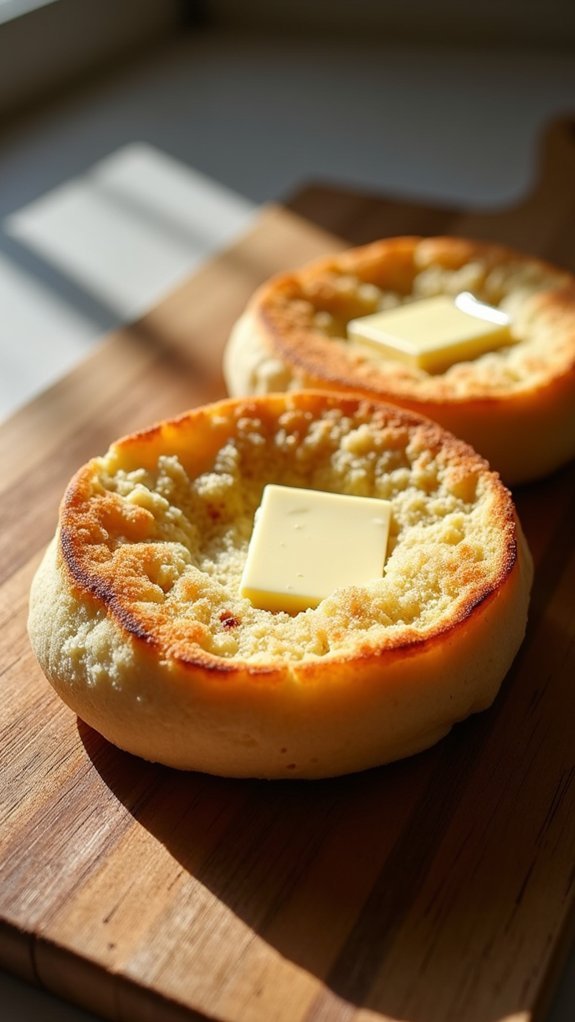
Start your Eggs Benedict journey with perfectly toasted English muffins, since they form the essential foundation of this classic dish.
Split your muffins horizontally using a fork (not a knife!) to create those signature nooks and crannies that’ll catch the hollandaise sauce.
Place them cut-side up on a baking sheet, and brush each half with a light coating of melted butter.
Pop them under the broiler at 400°F for 3-4 minutes, keeping a close eye to prevent burning – nobody wants a charred foundation for their breakfast masterpiece.
You’ll know they’re ready when the edges turn golden brown and crispy, while the centers remain slightly soft.
If you’re working ahead, you can keep them warm in a 200°F oven while preparing the other components.
step 2. Poach Eggs in Simmering Water

Perfect poached eggs require three critical elements: fresh eggs at room temperature, gently simmering water at 180°F, and a splash of white vinegar.
Fill a medium saucepan with 3 inches of water and add 2 tablespoons of white vinegar. You’ll know the temperature is right when small bubbles rise to the surface but don’t break aggressively.
Create a gentle whirlpool by stirring the water with a spoon, then carefully crack each egg into a small bowl first.
Slide your eggs one at a time into the center of the whirlpool – this helps the whites wrap neatly around the yolks. Set your timer for exactly 3 minutes for runny yolks, or 4 minutes if you prefer them firmer.
Remove with a slotted spoon and let drain briefly on paper towels.
step 3. Make Hollandaise Sauce

Creating a silky hollandaise sauce requires careful attention to temperature and timing throughout the process.
In a heatproof bowl, whisk 3 egg yolks with 1 tablespoon of cold water until combined. Place the bowl over a pot of barely simmering water, making sure the bottom doesn’t touch the water.
While whisking constantly, slowly drizzle in 1/2 cup of warm melted butter. You’ll notice the sauce beginning to thicken – don’t rush this part! If you see the sauce getting too hot, simply lift the bowl off the heat for a moment.
Once all the butter is incorporated, add 1 tablespoon of lemon juice, a pinch of cayenne, and salt to taste. The finished sauce should coat the back of a spoon and have a smooth, velvety texture.
Keep warm until ready to serve.
step 4. Place Canadian Bacon Slices

While your poached eggs are getting ready, heat a large skillet over medium heat and place 4 slices of Canadian bacon in a single layer.
You’ll want to cook each side for about 2-3 minutes until they’re lightly browned and heated through.
Don’t be tempted to crank up the heat – Canadian bacon can go from perfectly caramelized to overdone in seconds!
Look for a gentle sizzle and slight curling at the edges as your visual cue.
Once the first side is golden brown, flip each slice using tongs and repeat on the other side.
If you’re working in batches, you can keep the cooked slices warm by placing them on a paper towel-lined plate and covering them loosely with foil.
They’ll stay perfectly toasty while you finish the remaining components.
step 5. Assemble and Garnish Servings

The artful layering of Eggs Benedict begins with placing two toasted English muffin halves on each warmed plate.
Top each half with a slice of the warmed Canadian bacon you’ve prepared.
Carefully transfer your poached eggs onto the bacon using a slotted spoon, allowing any excess water to drain first.
You’ll want the yolks to remain intact – they’re the star of the show!
Now, generously spoon your warm hollandaise sauce over each egg, letting it cascade down the sides.
For the finishing touch, sprinkle fresh chopped parsley and a dash of paprika over the hollandaise.
A light crack of black pepper adds that final bit of sophistication.
Serve immediately while the eggs are hot and the hollandaise is still perfectly smooth.
Your guests won’t believe you’ve mastered this restaurant-quality classic!
Final Thoughts
Making perfect Eggs Benedict demands attention to detail, yet mastering this breakfast classic will elevate your brunch game to restaurant quality!
You’ll find that timing is everything with this dish – from poaching the eggs to whisking the hollandaise. Don’t let the fancy reputation intimidate you; with practice, you’ll develop an instinct for when each component is just right.
Remember that fresh eggs are your best friends for poaching, and keeping your hollandaise warm (but not hot) is crucial for serving success.
If you’re hosting brunch, try setting up a mise en place system before guests arrive. This way, you won’t be scrambling at the last minute!
Once you’ve mastered the basics, feel free to experiment with variations like smoked salmon or spinach for your own signature Benedict.